Interact

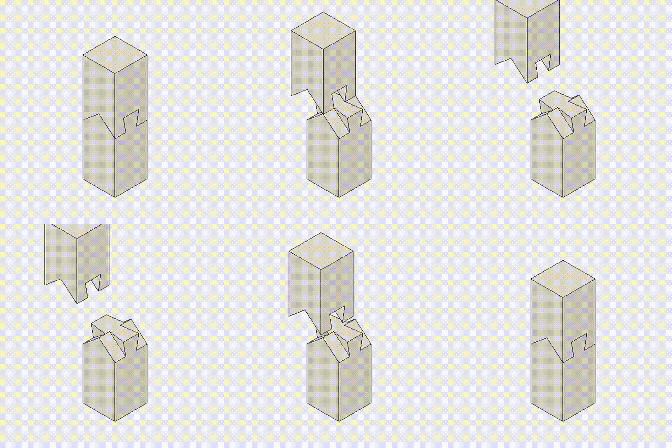

Traditional Japanese joinery gifs + David Shrigley’s ‘thumbs up’ teaser for Really Good on the Fourth Plinth in Trafalgar Square.
http://www.dezeen.com/2016/09/28/david-shrigley-thumbs-up-teaser-really-good-fourth-plinth-installation/
http://www.dezeen.com/tag/gifs/
Keith Tyson’s Art Machine
If there ever was a more confusing line between creativity, ownership and authenticity. An artist creating an algorithm to create performances, paintings and sculptures is a bizarre mix.
In a ten year experiment; ‘sculptures and performances that filtered out my own personal tastes, preferences and history’.
http://keithtyson.com/the-art-machine/
http://keithtyson.com/works/drawings-words/
Examples:
The Wit of Sol LeWittIn “Paragraphs on Conceptual Art” LeWitt wrote, “The idea becomes a machine that makes the art.”1 What do you think he meant by this statement? Summarize your ideas in a brief essay (200 words or less) describing your interpretation.
Interpreting LeWitt’s InstructionsSol LeWitt often hired people to execute his written instructions for works of art. Have someone read LeWitt’s instructions (below) to you while you carry them out. You’ll need a black crayon, a ruler, and paper. After you’re done drawing, switch roles and read the instructions to your partner while he or she draws. WORK FROM INSTRUCTIONS (1971): USING A BLACK, HARD CRAYON DRAW A TWENTY INCH SQUARE. DIVIDE THIS SQUARE INTO ONE INCH SQUARES. WITHIN EACH ONE INCH SQUARE, DRAW NOTHING, OR DRAW A DIAGONAL STRAIGHT LINE FROM CORNER TO CORNER OR TWO CROSSING STRAIGHT LINES DIAGONALLY FROM CORNER TO CORNER. Are there differences between the two drawings you made? Is it because the drawer did not correctly follow the instructions or is it because LeWitt’s written instructions can be interpreted in different ways?
https://www.moma.org/learn/moma_learning/themes/conceptual-art/sol-lewitt-and-instruction-based-art


Comments